





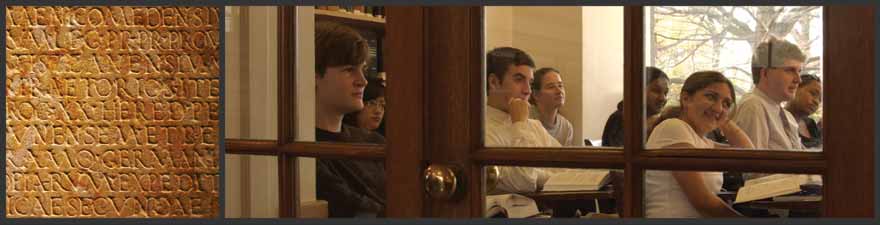


An outstanding feature of a Thomas Jefferson (TJ) education is the study of classical languages: Latin in the seventh and eighth grades, Greek in the ninth and tenth. These confer many benefits, including (1) a precise understanding of grammar and sentence structure that allows you to learn other languages more rapidly and helps you write better English; (2) knowledge of Greek and Latin word roots, which form many of our own words, both in everyday usage and in scientific and medical terminology; (3) a firsthand look at two important ancient cultures that lie at the heart of our civilization, involving history, geography, and archaeology; and (4) exposure to great works of literature, in the original, that have inspired people around the world and across the centuries.
The classics stand alongside math, science, English, social studies, and modern languages as a unique form of academic enrichment, no matter what your background. Some of our students eventually go on to continue this study for pleasure, in college or on their own. Sometimes, a student with high motivation and ability has done advanced work in either Greek or Latin or both by taking Advanced Classics as an upper-level elective.
Latin Our two-year Latin sequence gives you a great head start on the benefits listed above, if you are here in the seventh and eighth grades. By the end of your second year, you will be translating genuine Latin from works like Ovid's Metamorphoses. A few students have gone on to prepare for the Advanced Placement Latin exam in the junior or senior year.
Greek Our program introduces Greek via Homer, so that students actually begin the Iliad by the middle of their first year and then read parts of the Odyssey in their second. The Homeric poems appeal to people of all ages and constitute an ideal window onto ancient times; the students' work in English parallels their Greek as they read and discuss the Odyssey and other epics in translation. An alternative second-year Greek class, for accelerated students, introduces them to the history of Herodotus and then to other authors, such as Plato or Xenophon. Some international students are comfortable enough in English that they can take Greek, giving their English vocabulary and grammar skills an extra boost.