



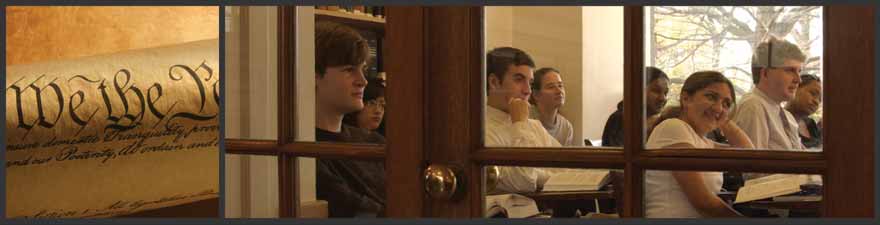


The social-studies curriculum begins with a specially designed class for seventh-graders, which covers government and the law in the first semester, world geography and economics in the second. As an eighth-grader, you take ancient and medieval history, which gives an introduction to major ancient cultures, not only Greece and Rome but also the Middle East, the Far East, and other parts of the world. The ninth-grade course in world history reviews the ancient and medieval periods briefly and then focuses on the modern world from the Renaissance onward.
In your final two years, you have one optional elective course – AP European History – and one required course, AP U.S. History, which is taken in the senior year. Occasionally, a student who arrives at Thomas Jefferson (TJ) as a junior or senior and who has had U.S. history elsewhere may be exempt from this requirement, and some international students may be exempt too. In either class, of course, you will end your year by taking the AP exam. Another AP history exam, World History, may be taken by some ninth-graders who are handling their work at a mature level and are willing to put in extra effort to prepare on their own time. In recent years, these students have usually done well, even though the exam is designed for older students.
In all of your social-studies classes, you will be participating as you do in English class: ready with facts from the assignment and ready to discuss your opinions and interpretation. You will write frequently, sharpening your ability to present your ideas. In the AP courses, you will write a longer final paper that may replace a final exam.
Students who go on the TJ trips abroad will spend time visiting important historical sites and learning firsthand about the who, where, when, and why of history.