








The science sequence at Thomas Jefferson (TJ) will introduce you to a way of thinking about the world and investigating it that is common to all branches of science. At the same time, it will get you started on the knowledge base that several of the main branches have developed, and it will lead you through at least one Advanced Placement science course.
Students take one science course per year for four years: Earth and Environmental Science in the seventh grade, Introduction to Chemistry in the eighth, Introduction to Biology in the ninth, and Introduction to Physics in the tenth. This lays the foundation for a solid understanding of the basics. Then, as a junior or a senior, each student elects a minimum of one AP science: biology, chemistry, or physics. The earlier course in each area prepares the students for the greater demands of these classes, which are (like all AP courses) equivalent to introductory college courses. Under normal circumstances, it will be possible to elect a second AP science, and if an extra opening is created in your schedule (typically through acceleration in math), you can take all three.
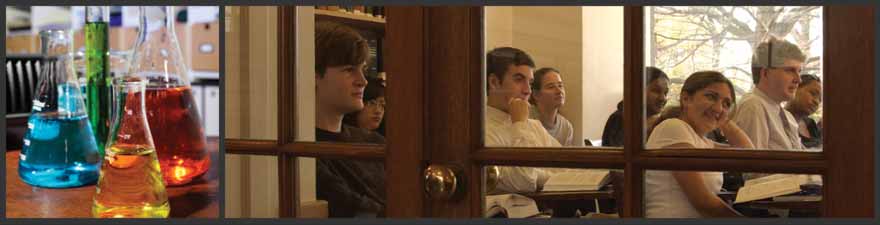
The laboratory is an integral part of a science course. For students in grades 7 to 10, experiments and demonstrations occur, for the most part, during class periods. The AP courses have a separate weekly afternoon time slot for their labs. In addition, most of the classes take field trips to see (for instance) a recycling facility, a wildlife refuge, or the dissection of a cadaver. The St. Louis area offers a wealth of such opportunities.
One other feature of the upper-level courses, the research paper, gives you the chance to learn an important skill for college by planning, researching, and writing a long paper over an extended period of time. Generally, this paper will take the place of a final exam. In some cases, it may be a double project that meets the paper requirement in two subjects, such as biology and history.